Translate

Saturday, January 18, 2014

Hawaii Dinner is Ready! Plus Fun Facts


Our Hawaiian dinner is ready! We made Ahi Tuna Poke with Fresh Ginger, Scallions, Sesame Oil, Soy Sauce, Cilantro, Sesame Seeds, and Macadamia Nuts. We served it with homemade Nori Chips(Baked Seaweed Sheets), Jasmine Rice, and finished with our Lomi Lomi Salmon. We prepared it with fresh tomatoes, white onions, and scallions. It was delicious! The flavors were so clean and fresh. I have never had Ahi Tuna prepared this way. The sweetness of the tuna with the spicy of the ginger and crunch of the macadamia nut was divine. The girls loved the Lomi Lomi Salmon. After baking our seaweed sheets we  broke off pieces of the Nori and made chips topped with jasmine rice and Lomi Lomi salmon. It was so much fun discovering their love of new food! We liked two different recipes for the Ahi Tuna Poke, so we used a bit from both. Here are the recipes we used tonight.


 Here are some fun facts we learned this week about Hawaii:


Hawaii is the only U.S. state that grows coffee. Coffee plantations in Hawaii make up 6,200 acres. In 2003, 8.5 million pounds of coffee were produced.

Sugar is mainly produced on Maui and Kauai, on altogether 70,000 acres. In 2002, 340,000 tons of raw sugar were produced. One ton of water is needed to make a pound of sugar.

Hawaii produces about 320,000 tons of pineapple each year.

Hiram Fong of Hawaii was the first Asian-American in the Unites States Senate. Fong is a descendant from Chinese immigrants and was elected to the Senate in 1959.

Hawaii has the highest population density in the United States.

In the 2000 census, more than 20 percent of Hawaii’s population claimed multi-ethnic backgrounds, far more than any other U.S. state.

Hawaii is the only U.S. state whose majority of people are non-white.

Hawaii has its own time zone. It’s called Hawaiian Standard Time. There is no daylight savings time in Hawaii, which means that in summer, Hawaii is two hours behind the U.S. West Coast, while in winter, Hawaii is three hours behind the U.S. West Coast.

The Hawaiian alphabet consists of only twelve letters. The five vowels are A,E, I, O,U. And the seven consonants are H,K,L,M,N,P,W.

Among all U.S. states, Hawaii has the highest percentage of women in the workforce, about 63 percent as of 2003.

More birds have become extinct in Hawaii than in any other part of the world. A total of 26 species died out and 27 more are endangered by changes in their natural habitats, forest destruction, mongooses and man.

The Hawaiian Islands National Wildlife Refuge northwest of Kauai is the world’s largest bird sanctuary. It is home to many seabirds.

Hawaii had the oldest newspaper west of the Rocky Mountains – the Sandwich Island Gazette, 1836-1839.

Hawaii has the highest number of married couples living with others, mainly because Hawaii has the lowest percentage of home ownership.

Hawaii has the highest life expectancy in the United States. Life expectancy for males is 75, for females 80 years.

Hawaii has the fewest overweight people in the United States. About 19.7 percent of Hawaii residents are overweight, compared to about 30 percent on the mainland.

Hawaii has a unique way of giving directions. To point people in the right path, local residents use “makai,” which means toward to sea and “mauka,” meaning toward the mountains.


Wednesday, January 15, 2014

HAWAII- Mahalo from the Aloha State


It may seem odd that I include one of our 50 states in our journey around the world. The truth of the matter is Hawaii possesses a distinct and unique culture of its own, very different from mainland America. I can remember the fresh Hawaiian air dancing with notes of tropical hibiscus and fresh plumerias as I stepped out of the Honolulu Airport on onto the Waikiki Beach. It was April 1998, and I had my dear sister Annie, and my best friend Genevieve. We were in for a real treat. One week  in Oahu away from our corporate jobs. It truly was paradise.


Snorkeling in Hanauma Bay, Hiking Diamond head, partaking in our first Luau, touring the Dole Pineapple plantation, watching Genevieve take surf lessons from a near centenarian native, soaking up the sun on the famous North Shore. It is a trip I will never forget. A year later, I returned to Hawaii. This time 10 days in Maui and Kauai. I must say I  favored the untouched raw natural beauty of Kauai and Maui to the congested tourist filled Honolulu. My favorite memory was kayaking in Kauai through the most serene waters and ending up in a beautiful waterfall. Pure nirvana.  


The term "Native Hawaiian" refers to  the people that arrived in Hawaii over 1,500 years ago from Tahiti and Polynesia. With only the stars to guide them, they sailed over 2000 miles in canoes to migrate to the islands. In 1778 Captain James Cook, native of England, sailed into Hawaii and had disastrous results. Traders and missionaries swarmed onto the Islands attacking many of the local customs and completely transformed and commercialized the economy with little regard for the natives.


In the last century sugar and pineapple plantations fueled Hawaii's economy bringing an influx of   immigrants from all over the world. Many coming from Japan, Korea, The Philippines, China, Portugal, and Puerto Rico.
                                                       
Lanai, under the leadership of James Dole, became known as the “Pineapple Island,” after becoming the world’s leading exporter of pineapple. This mix of immigrant ethnicities is what makes Hawaii’s population so diverse today.
                                                             
On December 7, 1941, the Japanese launched a surprise attack on Pearl Harbor on Oahu. Four years later, on September 2, 1945, Japan signed its unconditional surrender on the USS Battleship Missouri which still rests in Pearl Harbor today. In 1959, Hawaii became the 50th State of the United States. Hawaii is known for its Aloha spirit. The Aloha Spirit is a well known reference to the attitude of friendly acceptance for which the Hawaiian Islands are so famous. It also refers to a powerful way to resolve any problem, accomplish any goal, and to achieve any state of mind or body that you desire. In the Hawaiian language, aloha stands for much more than just "hello" or "goodbye" or "love." Its deeper meaning is "the joyful (oha) sharing (alo) of life energy (ha) in the present (alo)." Native Hawaiians believe that as you share this energy you become attuned to the Universal Power that the Hawaiians call mana. And the loving use of this incredible Power is the secret for attaining true health, happiness, prosperity and success.


Although Hawaii is filled with sandy beaches, blue-sky waters, amazing volcanoes, and glorious sunsets, the  beautiful natural environment is not all there is to enjoy in this earth-bound paradise. The culture and tradition of Hawaii are actually even more interesting.  The graceful Hawaiian dances, the meaningful and religious songs, and the various interesting art forms seem to be created with only one purpose, and that is to serve as instruments through which the beauty and the mystery of the place is expressed. I remember going to my first Luau and seeing young native Hawaiian ladies performing a traditional Hawaiian Hula. I was captivated by the gracefulness, poise, and elegance of the dance.  


According to some, the hula represents the spirit of Hawaii through graceful
 movements and captivating music. The hula is a local dance deeply rooted to
the religion of the natives. Hawaiians actually believe that the first hula was
performed by a god or goddess.  Because of this, the dance is considered more
as a sacred ritual than as a form of entertainment. But through time, the hula
became a part of celebrations and not just a spiritual performance or a form of worship. 


The cuisine of Hawaii is just as beautiful as the land. It is all about making use of the
fresh local delicacies such as fresh fish and citrus. We will cook traditional
Poke(Raw Tuna with ginger,  red chilies, scallions, soy, sesame oil, and toasted
 sesame seeds) and Lomi Lomi  Salmon(Smoked Salmon with scallions, Onions,
 and Tomatoes).
                                                     

 Sources: http://www.to-hawaii.com/hawaiian-culture.php

Thursday, January 9, 2014

GREECE-Dinner is Ready!!!

Our Greek Dinner is Ready! I never attempted Greek cuisine prior to this evening. I must say, I am hooked! The Spanakorizo sounded quite simple and not too exciting at first, but the flavors all came together so beautifully. The fluffy rice accented with the spinach, lemon, and olive oil was really delicious. The star of the show was definitely the Garides Saganaki however. The shrimp cooked in white wine, tomatoes, red chilies, ouzo, and then baked with feta, finished with lemon and herbs was fantastic! I had a loaf of baguette on the side to mop up all the wonderful sauce! We will definitely cook this amazing meal once again! The best part was the entire meal was purchased for only $12 and all ingredients were readily available at our local grocery store. Imagine a delicious gourmet meal that serves four and only takes about 30 minutes to prepare that costs a tad more than a McDonald's Extra Value Meal. Pretty amazing. We bid adieu to Greece for now, I cannot wait to experience this lovely country in person.

Sunday, January 5, 2014

GREECE-Famous Greeks, Fun Facts, and Recipes

                                                                     
Plato
 
 (c.429-327 BC) - Brilliant student of Socrates and later carried on his work. He gathered Socrates' ideas and wrote them down in a book. Plato founded the world's first university. He wrote down his teachings and people all over the world, even today, study the Greek philosophers

Aristotle
 
 (382-322 BC) - Discovered many things in science and biology. He wrote books about physics, poetry, zoology, biology, politics, governments, and more.
Archimedes
                                                              

Mathematician and an engineer. He designed a machine, called the Archimedean screw, which could make water flow uphill. His design has been used for almost 2,000 years, to take water from rivers to the fields. Archimedes was able to tell fool's gold from real gold.

Pythagoras
 
Mathematician. Founded the  Pythagorean theorem on right-angled triangles.

Alexander the Great
 
He was called 'the Great' because he conquered more lands than anyone before him and became the overall ruler of Greece.

Maria Callas
                                                      
Greek American Opera Singer. Known for her impressive vocal range, bel canto technique, and dramatic abilities. Most notable performances Tosca and Norma                                                            


Thank you to my dear friend and proud Spartan Kyriakos Marudas for sharing this Cultural Tradition from Greece:

Greek families celebrate the New Year by baking a sweet bread called tsoureki. A coin is inserted into one of the pieces and it's said that whoever gets the slice with the coin will have good luck for the entire year.


Fun Facts


No one in Greece can choose to not vote. Voting is required by law for every citizen who is 18 or older.
The world’s third leading producer of olives, the Greeks has cultivated olive trees since ancient times. Some olive trees planted in the thirteenth century are still producing olives.
According to Greek mythology, Athena and Poseidon agreed that whoever gave the city the best gift would become guardian over the city. Though Poseidon gave the gift of water, Athena’s gift of an olive tree was deemed by the other gods to be more valuable.


Greece has zero navigable rivers because of the mountainous terrain. Nearly 80% of Greece is mountainous
Approximately 98% of the people in Greece are ethnic Greeks. Turks form the largest minority group. Other minorities are Albanians, Macedonians, Bulgarians, Armenians, and gypsies.
Thousands of English words come from the Greek language, sometimes via the Roman adaptation into Latin and then to English. Common English words from Greek include “academy,” “apology,” “marathon,” “siren,” “alphabet,” and “typhoon.”
In the 1950s, only about 30% of Greek adults could read and write. Now, the literacy rate is more than 95%.
An old Greek legend says that when God created the world, he sifted all the soil onto the earth through a strainer. After every country had good soil, he tossed the stones left in the strainer over his shoulder and created Greece.
Greece has more than 2,000 islands, of which approximately 170 are populated.  Greece’s largest island is Crete (3,189 sq. miles) (8,260 sq. km.).
Over 40% of the population lives in the capital Athens. Since becoming the capital of modern Greece, its population has risen from 10,000 in 1834 to 3.6 million in 2001.
Continuously inhabited for over 7,000 years, Athens is one of the oldest cities in Europe. It is also the birthplace of democracy, Western philosophy, the Olympic Games, political science, Western literature, historiography, major mathematical principles, and Western theories of tragedy and comedy.
Some scholars say that the Greek civilization has been around for so long that it has had a chance to try nearly every form of government.

 
Greece enjoys more than 250 days of sunshine—or 3,000 sunny hours—a year.
Currently, Greek men must serve from one year to 18 months in any branch of the armed forces. The government spends 6% of the annual Gross Domestic Product (GDP) on the military.
Ancient Greece was not a single country like modern Greece. Rather, it was made up of about 1,500 different city-states or poleis (singular, polis). Each had its own laws and army, and they often quarreled. Athens was the largest city-state.
Until the late 1990s, the greatest threat to Greece was Turkey, as the two nations have had historical disputes over Cyprus and other territory for decades. After coming to each other’s aid after a devastating earthquake that hit both countries in 1999, their relationship has improved.
                                                 
 
Sources:http://www.ancientgreece.com/s/People/Main_Page/,http://resources.woodlands-junior.kent.sch.uk/homework/greece/famous.htm

Recipes:http://www.saveur.com/article/Recipes/Shrimp-with-Tomatoes-and-Feta-Garides-Saganaki, http://allrecipes.com/recipe/spinach-and-rice-spanakorizo/


GREECE-Madame Butterfly by Maria Callas


GREECE-OPA!!


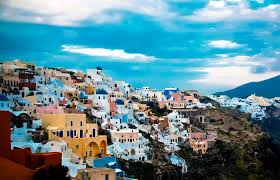
When I think of Greece, the first thoughts that come to mind are Plato, Socrates, Aristotle, Archimedes, picturesque waters, Greek Gods/Goddesses, and to be perfectly honest -succulent lamb on a rotating spit! One of my absolute favorite things in the world. Although I have never had the opportunity to travel to Greece, I cannot wait to visit one day and explore the majestic beaches of Santorini, ancient ruins of Athens, and absorb all of the rich culture Greece has to offer.


My surname, Siracusa, is actually a Greek city-state in Sicily. My first name Dina derived from the Greek Name, Constantina-from the ruler Constantine. So, even though my family has always identified with our Sicilian/Italian roots, we probably have more Greek ancestors than anything else.
 
So, where do we even start with a country that has played such an  integral in civilization as we know it? Let's start with the basics. Ancient Greece is where we found the foundations of Philosophy, Poetry, Government, Architecture, and Mathematics.  
                                                                    
Ancient Greece is considered by most historians to be the foundational culture of Western Civilization. Greek culture was a powerful influence in the Roman Empire, which carried a version of it to many parts of Europe. Ancient Greek civilization has been immensely influential on the language, politics, educational systems, philosophy, art and architecture of the modern world, particularly during the Renaissance in Western Europe.


Citizens living in countries that employ democracy have Greece to thank, for Greeks pioneered beliefs in government by the people, trial by jury, and equality under the law. The ancient Greeks pioneered in many fields that rely on systematic thought, including biology, geometry, history, philosophy, and physics. They introduced such important literary forms as epic and lyric poetry, history, tragedy, and comedy. In their pursuit of order and proportion, the Greeks created an ideal of beauty that strongly influenced Western art.


The cuisine of Greece is known throughout the world. It bears the fingerprints of many cultures that came into contact with Greece-Turkish, Roman, Middle Eastern. It was Archestratos in 320 B.C. who wrote the first cookbook in history. Greece has a culinary tradition of some 4,000 years. Ancient Greek cuisine was characterized by its frugality and was founded on the "Mediterranean triad": wheat, olive oil, and wine, with meat being rarely eaten and fish being more common. This trend in Greek diet continued in Roman and Ottoman times and changed only fairly recently when technological progress has made meat more available.


The staples of many contemporary Greek dishes today still include the use of Olive Oil, Yogurt, Fish, Lamb, Cucumbers, Eggplant, grains, and herbs. I remember watching one of my favorite cooking shows, Anthony Bourdain's No Reservations, and marveling at the Greek episode where the average life expectancy of the people from the Island of Ikaria-a 99 sq. mile island  in The Aegean Sea 30 miles west of Turkey was 95 years old. There are more healthy people on the planet here than any other place in the world.


What is their secret for longevity and health? They are insulated from all of the  conveniences of fast food culture of  modern society. This has helped them preserve customs and lifestyle habits that scientists believe explain their exceptional lifespan. The people of Ikaria consume mostly vegetables and beans that grow organically on the island, and little meat and sugar. They also consume large quantities of Extra Virgin Olive oil, goat milk-not cow's milk, wild greens that are rich in antioxidants, and healthy local herbal teas that are proven to lower blood pressure and risk of heart attacks. Makes a lot of sense to me!      
                                                                     
 
This week we will cook  a traditional vegetarian dish called Spanakorizo, which is a rice pilaf with Spinach, lemon and olive oil. We will serve it with   Garides Saganaki-Prawns cooked in tomatoes, feta,  ouzo,  garlic, mint,  and chilies. Cannot wait!